Friday, July 18, 2008

Return on Investment?

The release of MPs expenses is often an occasion to marvel at either the strange, the exorbitant or the minuscule. With the Conservatives publishing the whole MPs expenses for the last three months (see here) as part of the transparency equals trust agenda, it is interesting to see how much MPs spend on communications. This category of spend is sadly most frequently an undefined general amount, so we know that Jonathan Djanogly spent £18 April to June; while David Davies (that's Davies of Monmouthshire) spent £7494.76. The problem is we do not know how that £7000+ is broken down. Other MPs are far more transparent and offer a full breakdown and this is fascinating in terms of their communication priorities and the potential return on investment.

Surprisingly, flicking through the report I estimate at least half spent absolutely nothing on communication, this suggests that either their communication (such as updating or maintaining a website) is free, or it is purely media relations and swallowed within the budget of a staff member. Staff may also be updating the website etc and so there is no extra cost. The major spend is the Westminster Report, the MP's newsletters which vary in frequency (2-4 per year) and in delivery method (TNT, Royal Mail). The average cost for this is £2796.

Websites are the next priority and, for those that have an associated cost, are far cheaper. While it is not defined exactly what the spend is, of the 17 that have a cost associated with the website all but three are below £1000, and seven are below £500. The disparity is interesting, one does wonder why Tony Baldry's website cost £1882.94, though an excellent site it does seem high. This is particularly when contrasted with David Cameron who pays £246.25 to Reaper Enterprises Ltd for his constituency website a separate entity to WebCameron.

For me this is interesting as it displays a shift in priorities to some extent. Interviewing MPs in 2002 as part of a project working for Ralph Negrine, few talked much about websites or constituency newsletters, the majority were concerned about media relations. The Liberal Democrats were alone talking about the Focus newsletter, this seems now to becoming a widespread practice. However the question is on return on investment. Is up to £5000 per quarter or per annum (I did wonder if some of the expenses declared were one-off or yearly payments; some say they are, some are unspecified) a good investment for something that may line a budgie's cage, cat litter tray or go straight into the bin? Well the answer is yes as somewhere in that process the recipient may recognise that their MP has communicated with them, assume this means they are working on their behalf, and so the MP gains an incumbency benefit. Equally, and aside from winning votes, it is a good thing that MPs demonstrate they are acting as representatives. But can websites overtake the newsletter? This would be highly cost effective and perhaps have more impact on that incumbency value. The few MP's websites I looked at are very good, very much about the constituency, but do they have a pull factor that will get a constituent visiting and interacting with the MP?

Wednesday, July 16, 2008

The dangers of inconsistency

There is an opportunity, but also a danger, with the Internet; unlike printed matter you can update it and revise it. So policy, theoretically, can quickly be changed. But printed matter can also disappear, it is much harder to broadcast a leaflet around the world to show an inconsistency. Websites leave impressions and so if you want to and have the right software you can very simply go back to a previous incarnation of a web page and compare it with the new version. John McCain has done just that. In an argument over Obama's fitness to rule there was some contestation about whether Obama claimed the surge strategy in Iraq was working or not. On July 11th he did say just that, by the 14th there was a slightly more complex argument on offer. McCain has posted the two sites side by side (view here, snapshot is below).
This shows the dangers of saying something publicly, and especially on a website, then reversing that decision and trying to undo it. It is these moments when it is far easier to say actually I was wrong, but I suppose the risk is working out which will play worst in the perception of the voters: is it worse to (as McCain claims of Obama) he lied to make a political point; or is it worse to be wrong?

Tuesday, July 15, 2008

GQ versus Cosmo

There are two new sites dedicated to politics. The first, also with a street publication, Total Politics seems more aimed at the more male end of the market perhaps. It is a lifestyle magazine for those working in politics and is very much about the nuts and bolts of politics. June Sarpong, ex-T4 presenter among other things, has created an online rival Politics and the City. More feminine and fluffier, Clare Staples blogs through the eyes of her dog, June blogs her appearance on Andrew Marr and coming soon will be the Minogue sisters. The links are predominantly the sort of content that would attract Heat/Cosmo readers and not those of the Economist etc. Iain Dale's Total Politics is much more serious and oriented towards those active in politics; Sarpong seems to be talking more to the women in the street. But will these find a wider audience, in particular will Sarpong manage to get women interested in politics? Given that the students who take my political communication option in October will most likely be predominantly female I will be interested in their evaluation of the site and how it compares to others (not sure about the lipstick though).

Monday, July 14, 2008

Acceptable satire?

Cartoonist Barry Blitt has the front page of the New Yorker magazine, his cartoon is being described as satire but the images of Obama dressed as a Muslim, his wife Michelle as a terrorist and the symbolic placing of the US flag on the fire and Osama bin Laden's prortrait above that fire is a very power attack on the Democratic nominee. But is it acceptable? Obama says it has gone too far! Would Private Eye show a similar image? Is anything fair game for the satirist or is there a line that should be drawn? Interesting questions huh?

Friday, July 11, 2008

The importance of being street smart

Colin Byrne, CEO of PR Agency Weber Shandwick has launched some serious criticisms against Gordon Brown and his communication team, one that seems to be ever changing and permanently on the back foot. In his blog on July 8th he noted:

Quite what prompted the incompetents - as they clearly are these days for
all their fat salaries and big job titles and egos - in the No10 bunker to have
the PM telling us to eat up our crusts one day and be photographed waving a
glass of wine around the G8 dinner table as he tucked into the conger eel the
next is beyond this simple communications guy’s understanding.

He notes here the double standards that was pervasive throughout hte G8 summit and so undermined much of what was said about being frugal and managing waste. But in an article in PR week out today Byrne expands on Brown's problem:

There's no way that these mistakes would have happened when Alastair
[Campbell] was there because he had news sense, he was street-smart. From what I
can see there is no-one at Downing Street from Brown downwards who has any
street smart

It seems quite worrying when there is a call for Campbell to come back given the stories of him haranguing news editors. However, what Byrne notes is that hostile coverage for most of the time was attached to Campbell, Blair remained teflon up until the Iraq War and that dodgy dossier;that was the spin too far. Brown instead is the archetypal velcro political leader, all that is wrong sticks to him. His early attempts to appear un-spun soon turned off the audience and now he appears to have attached the label loser among a large proportion of British voters according to Wednesday's populous poll for the Times. The big question is whether a Campbell figure could work for Brown in the same way as Blair, is the problem that he has no sense of how to manage his image? If image is important, he seems to fail to get anythign right; is this his problem or is his problem that nothing is going right so he gets the blame. In other words which way does the circle go; is it image first or is it the economy stupid?

So maybe they did care!

Every news outlet yesterday predicted a derisory turnout around the 20% mark and claimed this would be an indictment on David Davis' decision to step down to run on a civil liberties platform. Maybe the people of Haltemprice and Howden decided to fly in the face of predictions, or rather maybe they wanted to demonstrate that they did care and were mobilised by the media. It has been shown that as results are announced in the US presidential elections on the Eastern seaboard it affects voter behaviour in the West (see Geoffrey Peterson's work), so why cant the media also have an effect in either increasing or decreasing turnout through their use of polls and predictions. I wondered if some of the 17,000 voters who turned out to tick the Davis box watched the news, were told they didn't care, thought actually I do and so went out and demonstrated their concern.

Thursday, July 10, 2008

Is this a push poll?

A push poll is a technique designed to gather the responses you want, or to persuade the 'participant' to think a certain way: a classic example was conducted a number of years ago by a certain tabloid newspaper. The question "in the light of the recent abductions of XXXXX do you think that paedophiles should be given mandatory life sentences", there are worse in politics. Some US push polls try to sell the idea that Barack Obama is in some way linked to Osama bin Laden, clearly thinking some Americans are stupid enough to take four out of five characters and the rhyming nature of the names as a link. Those examples aside that is the idea, so is this a push poll?


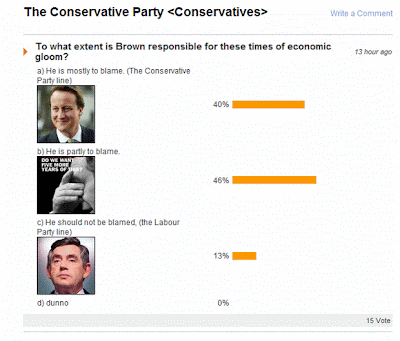
I argue it is, not because the question itself is loaded, and it does present the Conservative and Labour case, but this poll loaded onto the Conservative's Bebo profile, contains images that lead the reader to a conclusion. Given that many Bebo users are the young people we may expect (I stress may) to not have much political interest or knowledge, offering the message 'Do we want five more years of this' alongside the 'partly to blame' option suggests steering the reader towards the Conservative line. Currently it isn't working which perhaps indicates something about the Bebo users that engage with politics. Common sense suggests it is not solely Brown's mess but that he did not help the situation, I suggest that is a reasonably informed response and that is the majority albeit a narrow one. Is this practice ethical? Any views?

Sunday, July 06, 2008

Is this why no-one is listening?

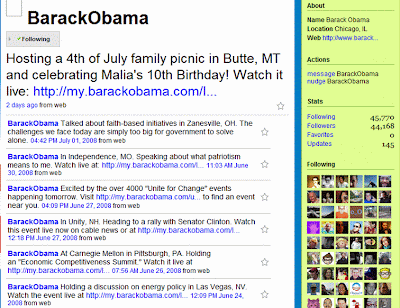
I make no value judgements here, rather I raise a question about strategy and to what extent one could be better than the other. Obama is unrelentlessly engaged in self-promotion and impression management. He is using Twitter to inform his 44,000+ followers on the message community what he is doing day-to-day. He is not a frequent twitterer but it is purely used to offer positive messages.
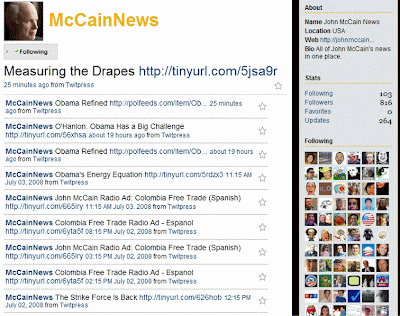
John McCain, while also promoting the odd campaign ad, largely Twitters about Obama. His strategy is to raise doubts in Obama as an outsider, as a credible president, as an honest man at times. Most of his messages link to PolFeeds.com, which is largely a blog that collects statements from all candidates. He only has 814 followers, and only follows 103 (Obama follows 45,000+ Twitter users).
Obama seems to have a constituency offline that are fairly devout, of course they may not all be American, so ineligible to vote, but that interest is their among the wired (or wireless) community. But is it also the nature of the messages that is attractive? Is McCain gathering support or does he need to offer more of a mixture and talk less about his opponent. Does this also account for Obama's lead in the polls, the strategy question is interesting and I do wonder if McCain is too negative in the face of an unremittingly positive opponent.

Saturday, July 05, 2008

Branding and Educating


This is a wonderful example of branding which, rather than bracketing off history, is selective in presenting the Conservative leaders: "For more than two hundred years... succeeded by being on the side of progressive change". Some of the 'achievements' of recent leaders seem a little desperate, and there are some great selections and omissions that are clear to anyone with a sense of history; saying that though it is easy to remember why, for example, Eden is remembered as a bad prime minister but not what he did get right. It has been posted to their Bebo and YouTube pages, and possibly more widely. A way of educating about the brand via social networks.

Thursday, July 03, 2008

Sex and Politics

I am not sure if this merits commentary really, it elicits some fairly negative comments on Youtube. What is the message, well at the most basic level you wont get laid if you support the Republicans. Given the positive tone Obama has tried to maintain, and his insider versus outsider positioning of himself, I am surprised this has been approved, if it has. I tried to work out when it was produced but it is posted by Mediacurves (worth checking out in itself) a week ago suggesting it is recent. Is this the standard of political debate the Democrats want to encourage among young people? How does this effect brand Obama?